
The twelve tribes of Israel are an earthly reflection of the twelve months, which reflect the twelve celestial cycles of the heavenly spheres. Each has its own character, its own personality, and its own place in the heavens.
Parashas Mishpatim tells of Moshe rising early in the morning, building an altar beneath the mountain of Sinai, and erecting twelve stones representing the twelve tribes of Israel.
Shemos 24:4
וַיַּשְׁכֵּם בַּבֹּקֶר וַיִּבֶן מִזְבֵּחַ תַּחַת הָהָר וּשְׁתֵּים עֶשְׂרֵה מַצֵּבָה לִשְׁנֵים עָשָׂר שִׁבְטֵי יִשְׂרָאֵל
He rose early in the morning and built an altar at the foot of the mountain, and twelve pillars for the twelve tribes of Israel.
Both as a collective and as individuals, the Jew has throughout history been represented by one person, who takes the blame for an entire nation. This phenomenon occurs even in contemporary society, where one Jew’s action is often generalized and attributed to the entire Jewish nation — for good or for bad.
The Dreyfus affair of the late nineteenth century is one such example: one Jew, falsely accused of treason, ignited an entire uprising against our people. That affair ultimately led to a unified effort on behalf of the dispersed Jewish people to create the modern State of Israel.
Similarly, in an earlier event, “Mordechai the Jew” refused to bow to a state official, which resulted in a decree to exterminate every living Jew. That brought about a nearly unparalleled unification of the Jewish people. In fact, the Gemara (Shabbos 88a) describes this unity — kiymu v’kiblu — as a moment of closure, in which the people collectively re-accepted the Torah. This event put to rest any claim that Israel had accepted the Torah at Sinai under duress, “under a mountain.”
Indeed, we beseech Hashem in the prayer Sim Shalom:
Sim Shalom
בָּרְכֵנוּ אָבִינוּ כֻּלָּנוּ כְּאֶחָד בְּאוֹר פָּנֶיךָ
Bless us, our Father — all of us as one — in the light of Your countenance.
We thus pray for Hashem’s blessing upon His people, to be seen as a unified people — as one.
Beis El: many stones become one
מֵאַבְנֵי הַמָּקוֹם · Bereishis 28:11
The Jordan: a path for the tribes
שְׁתֵּים עֶשְׂרֵה אֲבָנִים · Yehoshua 4:9
The choshen: twelve on one heart
עַל שְׁתֵּים עֶשְׂרֵה שֵׁם · Shemos 28:21
Throughout Tanach, the tribes are likened to, and represented by, stones. Perhaps in the same way that we refer to Hashem as Tzur Yisrael, the Rock of Israel, Israel represents Hashem on this earthly plane.
When the covenant to inherit the Land of Israel was about to be fulfilled, twelve stones were placed in the bed of the Jordan. It was upon these stones that the kohanim stood carrying the Ark of the Covenant, followed by the twelve tribes (Malbim on Yehoshua 4:9).
Yehoshua 4:9
וּשְׁתֵּים עֶשְׂרֵה אֲבָנִים הֵקִים יְהוֹשֻׁעַ בְּתוֹךְ הַיַּרְדֵּן תַּחַת מַצַּב רַגְלֵי הַכֹּהֲנִים נֹשְׂאֵי אֲרוֹן הַבְּרִית
And Yehoshua set up twelve stones in the midst of the Jordan, where the feet of the kohanim who carried the Ark of the Covenant had stood.
In fact, there were three instances of twelve stones being erected in this vein. According to Likutei Shas (there, citing Sotah 35b), the first involved Moshe in the land of Moav, the second Yehoshua in the Jordan, and the third, later, at Gilgal (Yehoshua 4:20).
The Mincha Ketana (citing Michah 7:15) comments that Yehoshua placed these stones purposefully protruding out of the riverbed, so that Israel as a collective would make its way across them into the Promised Land. These stones would later serve as a sign to the world — simna b’alma — at the time of the final redemption, l’eis ha’geulah ha’acharonah, that the Land of Israel belongs to these twelve unified tribes, the People of Israel.
The principle of maaseh avos siman labanim — “what our forefathers did is a template for what later generations will do” — may well be reflected in these twelve stones.
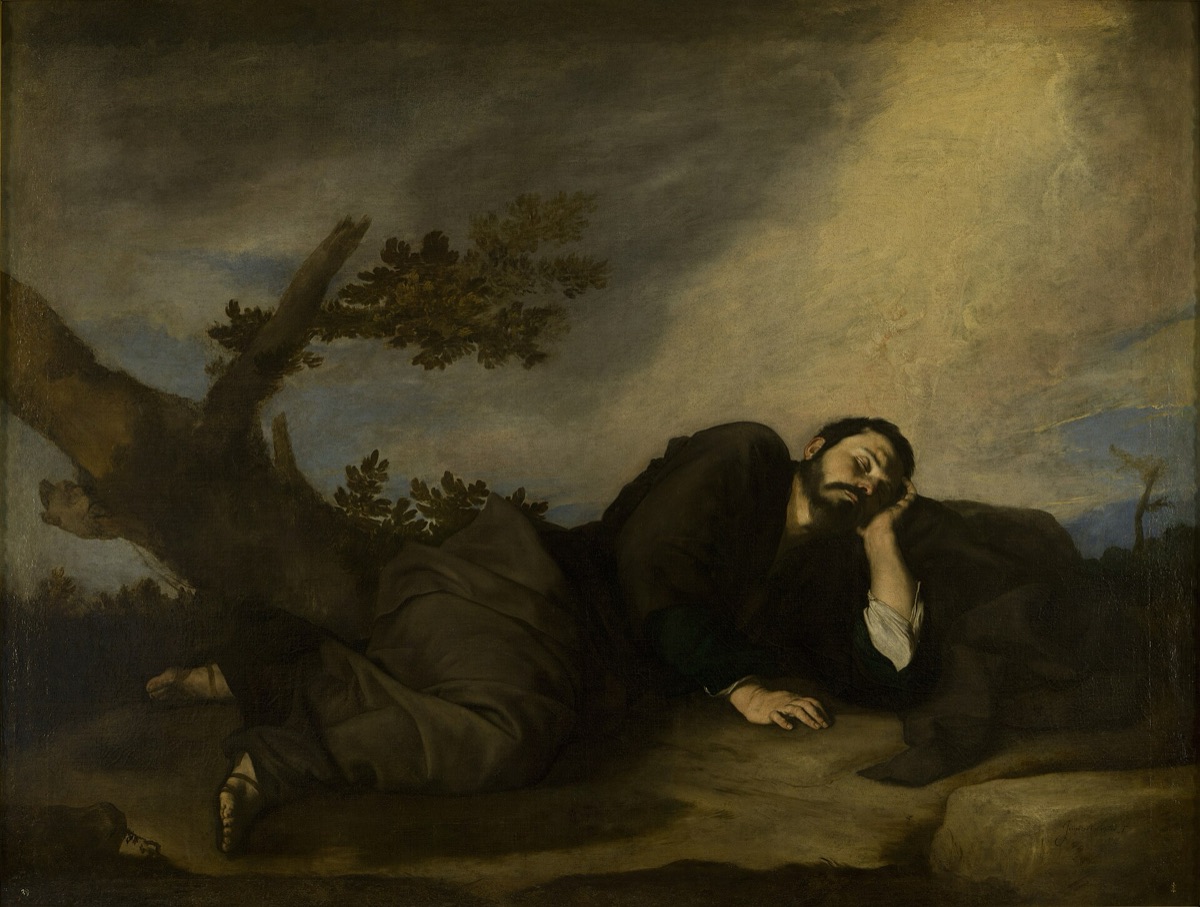
Years before Yehoshua led Israel across the Jordan, Yaakov went out of Be’er Sheva and traveled toward Charan, and dreamt. Chazal (Kli Yakar, Chizkuni and others) tell us that the place where Yaakov had his famous dream of the ladder was none other than Har HaMoriah, “upon which the future Temple would be built.” The Chizkuni identifies this “place” as the very place where Yitzchak was offered as an olah.
Bereishis 28:11
וַיִּקַּח מֵאַבְנֵי הַמָּקוֹם וַיָּשֶׂם מְרַאֲשֹׁתָיו וַיִּשְׁכַּב בַּמָּקוֹם הַהוּא
He took of the stones of the place and put them under his head, and lay down in that place.
Interestingly, the Ibn Ezra expounds on the word used when Yaakov placed the stones — מְרַאֲשֹׁתָיו, meraashosav, “under his head” — and characterizes “head” in the plural, as in margelosav (Rus 3:4): those precious gems.
A more common question among Chazal centers on Yaakov having placed numerous stones under his head, while upon waking those numerous stones are described in the singular.
Bereishis 28:18
וַיִּקַּח אֶת הָאֶבֶן אֲשֶׁר שָׂם מְרַאֲשֹׁתָיו
And he took the stone that he had put under his head.
The Kli Yakar, quoting the Midrash (Bereishis Rabbah 68:11), describes Yaakov as taking twelve stones, corresponding to the twelve tribes, which then melded together as one stone (see Chullin 91b). This unification of the twelve foretells a time when Hashem would elevate this place as the makom haMikdash, the Holy Place. And in such a place there was to be no quarreling or division among the tribes, even as each tribe would vie for this very holy spot.
And just as King David would gather monies from all twelve tribes into one pool for the purchase of this place — the threshing floor of Aravnah the Jebusite — so would the melding of these twelve stones come to symbolize the unity of Israel in that place, both for Yaakov and for his descendants.
Thus our forefather Yaakov sets the example, creating a template of tribal unity through the unification of these stones.
It must also be noted that Yaakov had now acquired the bechorah, the status of the firstborn. He had donned the very garment — the kesones — which Chazal tell us originally belonged to the very first-born, Adam, made by Hashem Himself after the sin in the Garden, to obtain from Yitzchak the blessing intended for the bechor.
Chazal also tell us that the bechor was originally intended to serve as the kohen (see Rashi on Shemos 19:22, equating the firstborn with the kohanim). The Kli Yakar expounds on this (Bereishis 37:3) in the context of yet another kesones — sewn by Yaakov himself for Yosef, whom he thus deemed his firstborn, symbolized by this very garment. And it would be a kesones that the kohen would later wear for the holy service.
Perhaps Yaakov, as the firstborn, also bore the status of the kohen l’Kel Elyon — the high priest. The high priest would wear a kesones, along with a breastplate, receiving prophetic answers through the Urim v’Tumim — all on the very spot where Yaakov saw his heavenly, divine prophecy.
Tradition holds that this very place would be where the Holy of Holies would stand. It would be in this very place that the Kohen Gadol, in his holy garments, would perform his service.
The Urim v’Tumim, in the breastplate, was used to “read” divine signals from Hashem (see Shemos 39:8–21). The breastplate held twelve precious stones, detailed in the Torah as representing the twelve tribes of Israel.
These twelve precious stones were unified on one holy breastplate, symbolizing the importance of the unity of the twelve tribes: Kulanu k’echad b’or Panecha — “all of us as one, in the light of Your countenance” — an essential phrase recited daily in Sim Shalom.
The Kedushas Levi tells us: Kudsha Brich Hu, Oraisa v’Yisrael chad hu — “Hashem, the Torah and Israel are One.”
And it would be used on the very same place — the Makom — where Yaakov had that famous dream. There he had placed twelve “precious” stones — אַבְנֵי, avnei, in the plural — under his head, and upon waking they were one unified stone, expressed in the singular: אֶבֶן, even.
Meraashosav, “under his head” — and the breastplate sat just beneath the head of the kohen.
Maaseh avos siman labanim.
Indeed, it is up to us, Yaakov’s children, Bnei Yisrael, to wake up to the reality that our unity is essential to our divine connection. And it is only through our unity that we can bring about ha’geulah ha’acharonah, the Final Redemption.
May it come soon, in our days.
© J.S. Silverstein · Beor Panecha