
The parashah details the season during which the spies toured the Land of Israel:
Bamidbar 13:20
וְהַיָּמִים יְמֵי בִּכּוּרֵי עֲנָבִים
And the days were the days of the first ripe grapes.
It is interesting to note that the parashah describes how a group of Jews — more than a minyan — made an aliyah l’regel to the Land in the season of one of the Shalosh Regalim. And this group was called meraglim, “spies.” The root of meraglim is identical to the key word in Shalosh Regalim.
Rabbi Meir states (Sanhedrin 70b) that the Tree of Knowledge in Gan Eden was the grapevine, the gefen. Other opinions name other fruits, but there may be a compelling case, derived from this very parashah, which substantiates Rabbi Meir’s view.
Bamidbar 13:23
וַיָּבֹאוּ עַד נַחַל אֶשְׁכֹּל וַיִּכְרְתוּ מִשָּׁם זְמוֹרָה וְאֶשְׁכּוֹל עֲנָבִים אֶחָד
They came to the Valley of Eshkol, and cut from there a branch with a single cluster of grapes.
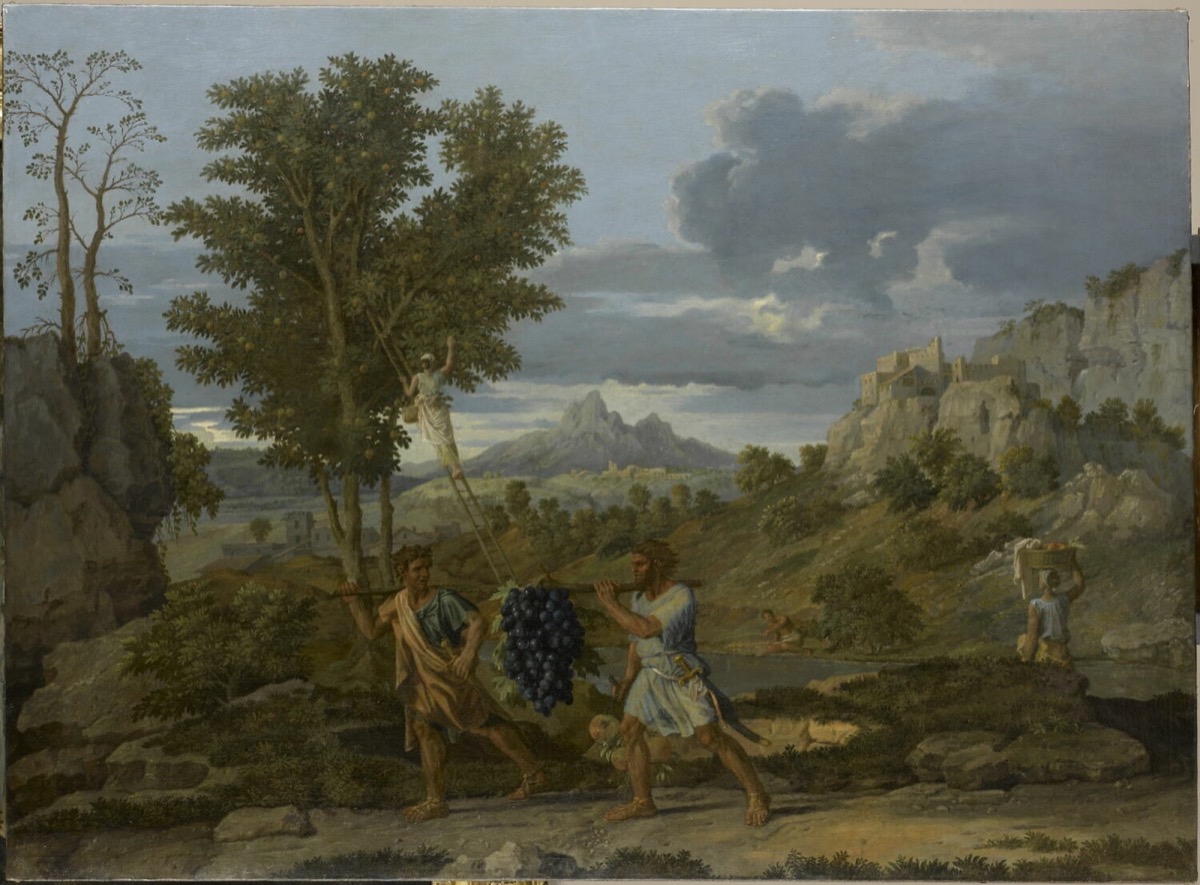
The word eshkol appears twice more in this same narrative, lending weight to the term. This was, of course, the iconic, enormous cluster of grapes which the spies carried back to the camp on poles.
The nachash, the serpent of the Garden, made his case to Chava by telling her the fruit of the Tree would make her like God, knowing good and evil. And the woman saw that the Tree was good to eat, a delight to the eyes — v’nechmad ha’etz l’haskil — and that the Tree was desirable to make one wise (Bereishis 3:6). L’haskil shares the same root as eshkol in our parashah — and here eshkol identifies itself as a cluster of grapes.
Twice the parashah repeats the spies’ general mission: lasur es ha’aretz, “to tour the Land” (Bamidbar 13:16–17).
This verb — lasur — makes another appearance in the very last portion of the parashah, the one dealing with tzitzis. While this section seems completely out of place with the rest of the parashah’s narrative, it actually proves to be an insurance policy to prevent a nation, or an individual, from going astray.
It is well known that tzitzis represent the entirety of the 613 mitzvos, worn on four-cornered garments. They serve to remind the wearer not to go astray: not to follow one’s eyes, nor allow one’s heart to be seduced into any inappropriate impulse or behavior. The admonition reads:
Bamidbar 15:39
וְלֹא תָתוּרוּ אַחֲרֵי לְבַבְכֶם וְאַחֲרֵי עֵינֵיכֶם אֲשֶׁר אַתֶּם זֹנִים אַחֲרֵיהֶם
And do not stray after your heart and after your eyes, after which you go astray.
The Torah employs the identical verb used to describe how the spies toured the Land. In that context, they were to tour the Land and report their findings. Here, we are commanded to avoid following our eyes and our hearts: v’lo sasuru — “and you shall not follow.”
The literal difference between lasur and v’lo sasuru is the letter aleph contained in the admonition v’lo — “do not stray!” This aleph separates the lamed of v’lo from the verb sasuru. Without the intervening aleph, which creates the warning not to stray, the directive becomes a positive command — lasur — just like what the spies did when they were sent to visually explore the Land, and went astray.
The aleph is composed of a diagonal vav along with two letters yud, yielding a sum of twenty-six. This sum represents the Tetragrammaton, the Name of Mercy.
Thus, if one cleaves to Hashem, and places Hashem between themselves and that which may lead them off the path, they will not be tempted lasur — to go astray.
The 613 mitzvos are the barrier and discipline that help us avoid such temptation. The tzitzis we wear serve as a constant reminder to keep Hashem always in our sights and in our hearts. This way, we can avoid going off the path.
May we always strive to stay on the path, which will ultimately lead us into the Promised Land, with the Rebuilt Temple.
© J.S. Silverstein · Beor Panecha