
Recited twice daily, the Shema is arguably the most essential and foundational tefillah, proclaiming Hashem as the One and Only.
Devarim 6:4
שְׁמַע יִשְׂרָאֵל ה׳ אֱלֹקֵינוּ ה׳ אֶחָד
Hear, O Israel: Hashem is our God, Hashem is One.
But just what does this mean? There are libraries of commentary on the infinite depth of this proclamation. Taking a more simple approach, one may ask: what are we asserting? We are stating that Hashem is One: indivisible, infinite, and everything that exists. We are in essence stating that everything is Hashem, and Hashem is everything.
In other words, Hashem, the Ein Sof — the Infinite — is One. Thus, Infinity is equal to One.
How can Infinity equal One?
A simple, but complex, mathematical equation may well explain this seemingly impossible assertion.
Moshe Rabbeinu is described in the Torah as the humblest man who ever lived:
Bamidbar 12:3
וְהָאִישׁ מֹשֶׁה עָנָו מְאֹד מִכֹּל הָאָדָם אֲשֶׁר עַל פְּנֵי הָאֲדָמָה
The man Moshe was exceedingly humble, more so than any person on the face of the earth.
Note the particular use of pnei, “face,” in this context. It is the root of panim, as in panim el panim, “face to face,” which relates to Revelation.
He was also the man who came closest to knowing Hashem. Is this mere coincidence, or is the Torah teaching us something essential? Is humility the currency of closeness to Hashem — the greater the humility, the closer one gets? If so, it is something we can learn from and emulate: a pathway to follow in the ways of Moshe, approaching ever closer to Hashem.
In the closing tefillos of Shabbos we recite Vayiten Lecha, whose closing paragraphs relay a passage from the Gemara:
Megillah 31a
כׇּל מָקוֹם שֶׁאַתָּה מוֹצֵא גְּבוּרָתוֹ שֶׁל הַקָּדוֹשׁ בָּרוּךְ הוּא, אַתָּה מוֹצֵא עַנְוְתָנוּתוֹ
Rabbi Yochanan said: Wherever you find the might of the Holy One, Blessed be He, you find His humility beside it. This is written in the Torah, repeated in the Prophets, and stated a third time in the Writings.
This reflects the equation between humility and greatness, exemplified by none other than Hashem Himself. We, as representatives of Hashem’s purpose in this physical world, must strive to emulate this core value.
Rabbeinu Bachya, in his introduction to Parashas Behar, details this very message. The righteous reveal their nature through shiflus, modesty, while the wicked do so through gasus ruach, haughtiness. Shiflus is the highest measure attainable (see Chullin 89a), and our greatest luminaries — the Avos, Moshe, Aaron and David — all describe themselves, see themselves, as devoid of ego. The Shechinah dwells only where there is a humble spirit (see Yeshayahu 57:15), and the Torah itself can be fulfilled only through that humbled spirit. As the Gemara asks (Taanis 7a), why is the Torah compared to water? Just as water flows downward, the Torah cannot be realized in a high place; it must flow down to the lowest level. Har Sinai, too, was chosen from all the mountains because it was the lowest. And the voice of Hashem was “walking” below, through the midst of the Garden.
Such is the place where the Shechinah dwells: in the lowest of places, devoid of haughtiness and ego.
It makes sense. As the ego eclipses one’s vision, one becomes increasingly blind to — occluded from — the Source from which all is derived. The ego becomes the self, the source. The greater the ego, the more the self, until the ego becomes all-encompassing:
The self becomes the center of one’s universe.
The extreme — but ever more common — example of this tendency is the narcissist, who seeks others to fawn over and worship them, making themselves into a god-like figure: a god of oneself. Unfortunately, this has become endemic to our society, which, by no coincidence, has all but dismissed G-d from the equation. Everyone competes to become the greatest god of all.
But this quest serves a false god. The ego blinds one from the Source, believing everything to be self-conceived and self-produced, worthy of praise, adoration and worship. It is artificial and superficial, devoid of spirit, overflowing with physicality, lacking accountability, stuffed with egotism and hedonism — insatiable, perverse and ever-fleeting.
True connection to oneself begins with recognizing the Source of it all, and connecting to that Source. We can — and must — develop ourselves with all our G-d-given gifts. That is our purpose. Knowing and exercising our unique talents, and our shortcomings, while cleaving ever closer to Hashem completes us in this world and in the World to Come.
And what does Moshe’s anivus, his humility, actually mean? It certainly does not suggest a lack of confidence. Although he repeatedly petitioned against leading Israel from bondage to the Promised Land, he finally accepted the hardest task ever assigned: to face the most powerful man on earth, the king of Egypt, regarded as a divine being, and demand the release of the Israelite slaves. He would also lead a most recalcitrant, stiff-necked people through forty years in the desert.
Moshe nullified his ego, allowing Hashem in.
If one were to quantify Moshe’s ego, it would be as close to zero as any person in the world. As the Torah tells us, he was the humblest of all. Thus Moshe’s ego approached zero — but never quite touched it.
Moshe sinned, and was punished by being kept from entering the Land of Israel. His angry impulse in striking the rock showed a flaw in his obedience, and his closeness, to Hashem. He did not completely nullify his ego. That disobedience, however slight, caused a separation from Hashem, however momentary, and prevented his complete fulfillment in this world. He came as close as the boundary, but never set foot inside the Land.
Had he been a “perfect” human, one can imagine he would have known Hashem even more. Still, Moshe came closer to the Infinite than any other person. To quantify this, one could use a basic tool of calculus: the limit.
1x → ∞ as x → 0
In a fraction, as the denominator — the number on the bottom — gets smaller, the value of the fraction grows larger. As the denominator, x, approaches zero, the value of the fraction approaches — but never quite reaches — infinity. Infinity, by definition, can never be reached; one can only arrive at a finite point.
Tehillim 115:16
הַשָּׁמַיִם שָׁמַיִם לַה׳ וְהָאָרֶץ נָתַן לִבְנֵי אָדָם
The heavens are the heavens of Hashem, and the earth He gave to mankind.
As Hashem is One, the One “above us,” that value sits in the numerator: One. Thus the smaller the denominator (relative to the numerator, which here equals One), the greater the value of the whole fraction.
Dividing one by zero is mathematically impossible — even “heretical.” It simply is not allowed; it does not work. But calculus offers a workaround: it lets such a fraction approach, but never touch, the infinite, even as it gets ever closer. Touching that endpoint would contradict the very essence of infinity. You can’t quite get there, because “there” would be a finite point. It keeps going, never ending — hence, infinite.
Moshe came closest to the Shechinah, His Presence. Known as the humblest man on earth, his ego — the x of the denominator — came as close to zero as any person’s. This allowed Moshe’s spiritual “value,” in the fraction analogy, to come as close to the Infinite, the Ein Sof, as any human could.
We humans, His creation below, are the denominator, situated here in this lower realm. The more we minimize our egos, the greater our spiritual value becomes, and the closer we approach the Infinite. We must always be conscious of what is above us, and know how the ego displaces Hashem’s presence within us; as we minimize it, we come ever closer to the Ein Sof.
The act of nullification comes into play each year in the Pesach season. Chametz, leavening, is likened to the ego: puffed up and self-centered. We associate chametz with the yetzer hara, the evil inclination that constantly stalks us, taking aim at our better senses and working overtime to separate us from our Divine consciousness, luring us into its egotistical lair.
The yetzer hara is associated with the Malach HaMaves, which was momentarily eradicated on that first Seder night in Egypt, leil shimurim. We had momentarily eliminated all chametz from our lives.
Bitul chametz — the nullification of leaven, and homiletically of the ego — is practiced just before Pesach, when we became a free people. We would no longer serve Egyptian taskmasters; we would be ovdei Hashem, servants of our true Master. We were on our way to receiving the Torah at Sinai, with the goal of returning to a state in which the Malach HaMaves would have been eradicated — of re-entering the proverbial Garden. But it was not to be, at least not at that time.“Nullification” means “having no value.” In German, the word for zero is null. We actively and consciously strive to eradicate the chametz from ourselves, to grow ever closer to Hashem, without limits. On Pesach we remove the leaven from our lives to symbolize our spiritual freedom and closeness to Hashem, who freed us to become His servants.
The Ein Sof, the infinite and limitless nature of Hashem, is found within each of us. As we follow in His ways with Torah and mitzvos, we draw ever closer to Him, reflecting His light as Moshe did when he came down from the mountain. The light radiating from him was so intense that he had to wear a veil, a masveh, except when he taught Torah.
We are each situated at the very center of our own personal universe.
As noted, we are representatives — messengers — of Hashem. The center of a number line is called the origin, and the origin is zero. In Hebrew, zero is אֶפֶס, efes. A Kabbalistic name for Hashem means “without end,” the Infinite: אֵין סוֹף, Ein Sof.
The two terms share the letters aleph, peh and samech: the Ein Sof is contained within efes. The samech and peh spell sof, “end.” One counts until the count is done — though in some cases, it never ends. Indeed, the infinite is mathematically, physically and homiletically related to zero: the symbol for infinity is two adjacent zeros, like the number eight lying on its side.
Two letters remain that set the Ein Sof apart from efes: the yud and the nun.
The yud is said to represent Olam HaBa, the World to Come (Menachos 29b; Kli Yakar on Bereishis 2:4, citing Bereishis Rabbah 12:10), in contrast to Olam HaZeh, where we may not quite attain that heightened state. According to the Tur (Shemos 32:19), the yud can also represent the Ten Commandments, which are said to contain the entirety of the Torah (Shabbos 86b). Living a Torah life brings one ever closer to Hashem.
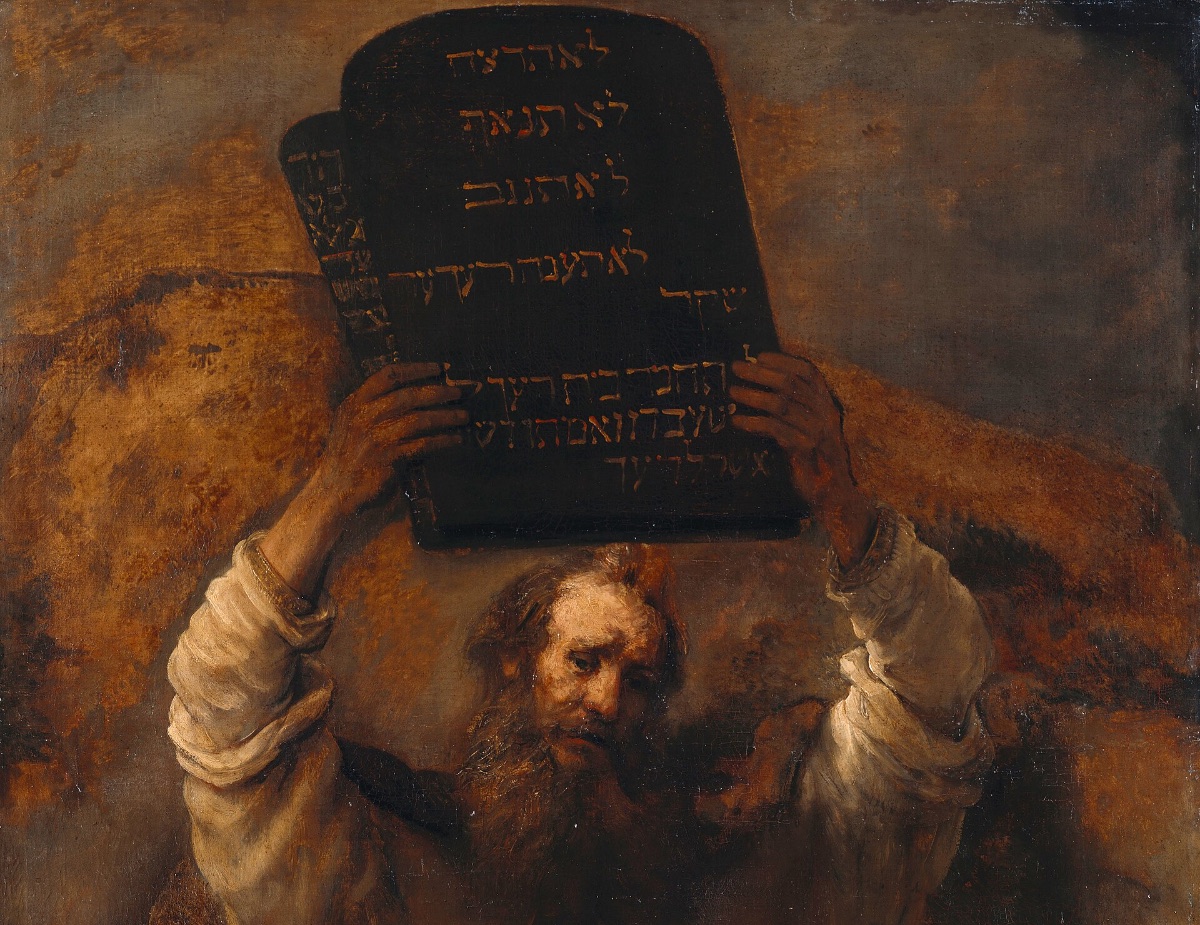
The Tablets were said to have been hewn from the Throne of Glory, the Kisei HaKavod. Made of sapphire, the second set was carved by Moshe himself, and the sapphire chips were said to make him a wealthy man (Nedarim 38a). The Mishkan, and later the Temple, existed chiefly to house the Aron, which in turn housed the Tablets. Their letters were carved clean through yet read correctly from both sides — a physical impossibility — and the final mem and the samech, both shaped like a zero, hung miraculously in midair.
This most holy of objects is a Divine example of “something residing within nothing”: yesh b’ayin.
Existence itself resides within, and by virtue of, the Ayin — the Ein Sof. The Lubavitcher Rebbe notes that the Tablets simultaneously occupied, and did not occupy, space. Inconceivable to us, it may offer a real-world picture of the relationship between the infinite and the finite — between Hashem and us. Homiletically, the essence of the Torah within these miraculous Tablets lets us glimpse the Infinite, which is the obligation of every Jew: to embody the entirety of the Torah, which brings us ever closer to Hashem, the Ein Sof.
The nun of Ein Sof may represent its numerical value: fifty. The Gemara (Rosh Hashanah 21b) records that fifty gates of understanding, binah, were created in the world, and all but one were given to Moshe, as it says:
Tehillim 8:6
וַתְּחַסְּרֵהוּ מְּעַט מֵאֱלֹקִים
You made him only slightly less than the Divine.
Moshe came the closest to understanding Divinity. The Sefer Yetzirah, too, speaks of fifty levels of understanding. Through that understanding, and by cleaving to Him, we can approach the highest level of self-nullification — approaching an understanding of Divinity. An essential element of an ever-closer relationship with Hashem, of striving for the Infinite, is minimizing our own egos, to “approach zero,” like Moshe Rabbeinu.
Shema Yisrael, Hashem Elokeinu, Hashem Echad. So how can One equal Infinity?
When Hashem created the world, He had, as it were, to make Himself imperfect in order to make an imperfect world. Our task, as beings created in His image with free will, is to make choices that align with Hashem’s order of things, the seder olam, with the Torah as our manual for this holy task.
To know on an ongoing basis — not just when we recite the Shema — that Hashem is both Infinite and One at the same time, always and forever, requires our active participation. It requires us to cleave to Hashem and to know that everything that happens, everything that is, comes from Hashem, the One, the Infinite, the Ein Sof. It is our task of tikun olam, l’shem yichud Kudsha Brich Hu: the unification of din and rachamim.
That is why we recite the Shema twice daily: as a refresher, reminding us of our purpose by surrendering the yetzer hara that emanates from our egos — avoiding the se’or, the leaven, the egotistical Esav inside each of us. Reciting it twice daily bookends our day. And we precede it with a blessing reminding us that Hashem chose us, His children of Israel, with love. It is more than a mathematical exercise. It is an act of love — mutual love between us and the Aibeshter.
The Chida notes on Shema Yisrael that two essential elements of our faith are found within this pasuk: shemiras hadibur, guarding one’s speech, and anavah, humility, as Moshe Rabbeinu was described. These are the foundation of the Torah.
Using the gift of speech to recite the Shema encompasses both. Verbally proclaiming that Hashem is One brings about the tikun of l’yached Kudsha Brich Hu, and this proclamation of the Unity of Hashem parallels our personal quest to unify our own hearts in His service: v’yached levaveinu l’ahavah ul’yirah es shemecha. At the same time, we strive toward perfect deveikus by minimizing the ego that obstructs that path.
The Chida makes another profound observation, citing the Mekubalim: the first letters of the first two words of the Shema are shin and yud. The Berditchever Rebbe reads the first word of the Torah, Bereishis, as bara yesh: Hashem, the Ein Sof, created existence itself — yesh — from nothingness, yesh me’ayin, ex nihilo.
Since the purpose of Creation was for the Jewish people to cleave to Hashem and spread His light to the wider world while unifying His Name, the first letters of Shema Yisrael spell yesh — existence itself. By reciting the Shema, a Jew proclaims that Hashem is One while simultaneously proclaiming the very purpose of Creation: bara yesh.
This confirms the goal of every Jew: to minimize one’s ego through the service of Hashem, and to strive for a permanent Divine consciousness that connects us ever closer to the Ein Sof, as a tikun olam — l’yached shem Kudsha Brich Hu. We are active participants in creating a better, more unified world, both within ourselves, to fulfill our individual purpose on this earthly plane, and in serving to actively unify His holy Name.
It is our life mission. The Infinite resides within us. If Hashem is everything, then we are part of Hashem, for we are something. Hashem is inside each of us — if we let Him in, and let ourselves out.
We can approach perfect deveikus with Hashem, the Infinite One, through self-nullification, by immersing ourselves in the fountain of the Torah — Miriam’s well of Torah.
It is our choice. Choice is what defines us as human beings “made in His image.” Only thus can we achieve our purpose, growing ever closer to Hashem, and reach our complete realization — without limits.
Shema Yisrael!
© J.S. Silverstein · Beor Panecha