
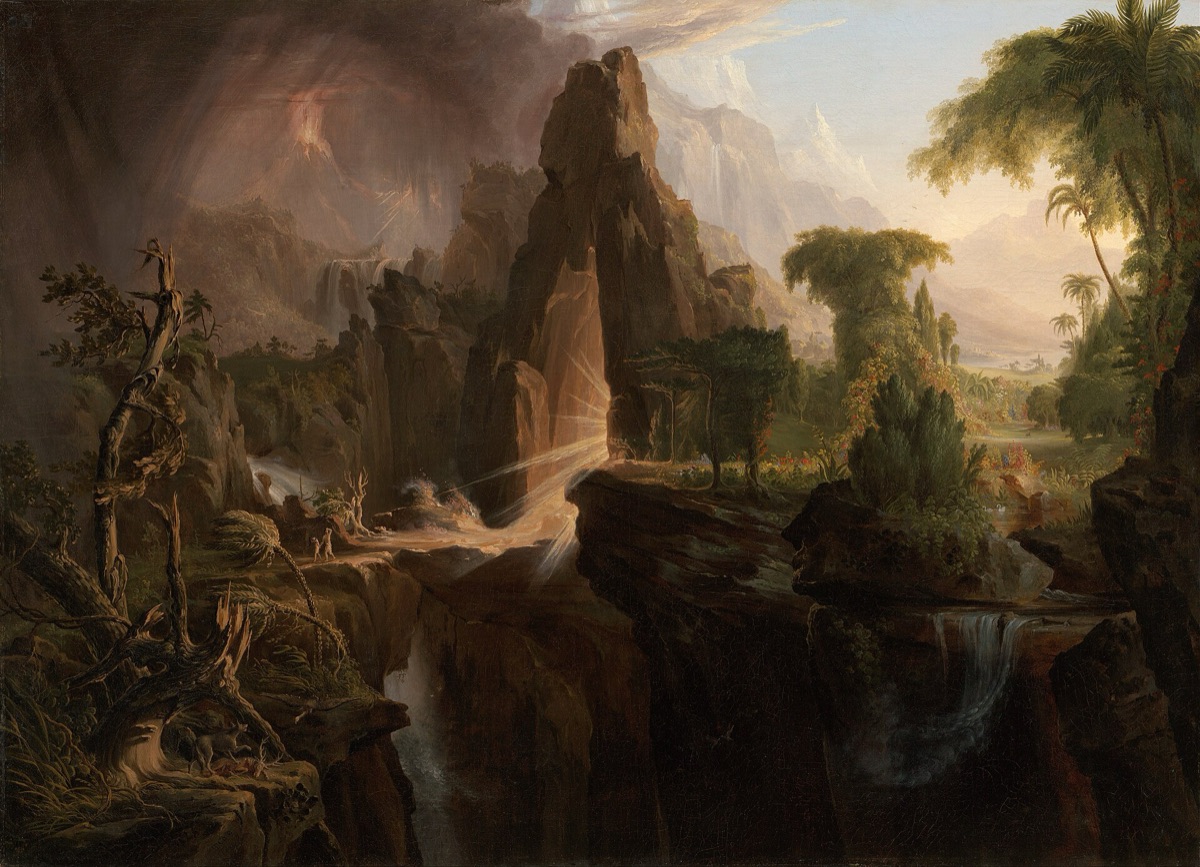
Chazal tell us that Hashem planted the Garden of Eden before Creation itself (Pesachim 54a; Nedarim 39b). In that Garden He planted the Eitz HaChayim and the Eitz HaDaas Tov VaRa, both specifically placed in the center of the Garden — b’soch hagan (see Targum and Chizkuni on Bereishis 2:9).
Bereishis 2:9
וְעֵץ הַחַיִּים בְּתוֹךְ הַגָּן וְעֵץ הַדַּעַת טוֹב וָרָע
And the Tree of Life in the midst of the garden, and the Tree of Knowledge of good and evil.
Adam was commanded to eat from every tree in the Garden except the Eitz HaDaas. The first couple’s diet came entirely from trees — every tree but the one in the center of the Garden. No meat, no other delicacies; just the fruit of the trees.
Had they not eaten from the Tree of Knowledge, there might have been no need for the Torah’s list of kosher and non-kosher animals — a list found at the very center of the Torah. We would have lived on the fruit of the trees, as Adam was commanded. Because of the sin, and in the image of the sin itself, we were given commandments about what we may and may not eat.
Adam and Chava, together and individually, received other punishments. Above all, they became mortal. They would now have to work the land:
Bereishis 3:19
בְּזֵעַת אַפֶּיךָ תֹּאכַל לֶחֶם
By the sweat of your brow shall you eat bread.
They — and we — would eat other foods, but no longer effortlessly. We would have to sweat in order to eat. Paradise was lost.
And the snake, which seduced Chava, would be punished forever, and famously. It would lose its legs and be made to crawl:
Bereishis 3:14
עַל־גְּחֹנְךָ תֵלֵךְ וְעָפָר תֹּאכַל כָּל־יְמֵי חַיֶּיךָ
On your belly shall you go, and dust shall you eat all the days of your life.
A gloss on Rashi here (Tosefes Rashi) points to the pasuk in Vayikra that forbids eating creatures that crawl on their belly — and, immediately after it, creatures that go on four legs. The two narratives point to each other: the snake once walked on legs, and lost them as its punishment.
Vayikra 11:42
כֹּל הוֹלֵךְ עַל־גָּחוֹן וְכֹל הוֹלֵךְ עַל־אַרְבַּע… לֹא תֹאכְלוּם כִּי־שֶׁקֶץ הֵם
Whatever goes on its belly, and whatever goes on four legs… you shall not eat them, for they are an abomination.
Both narratives center on forbidden food: in Bereishis, the fruit of the Tree; in Vayikra, the snake itself, among others.
The laws of kashrus are chukim — divine laws given without a reason or an incentive. They are the word of Hashem, and we obey. Yet the snake in the Garden — the Satan — used reason and persuasion to seduce Chava: “You will not die… it will make you wise.” Hashem had commanded Adam not to eat from the Tree; the Satan used reason to persuade Chava otherwise. Such is the nature of the Satan, the yetzer hara.
When the Torah spells out the laws of kosher animals, it offers no persuasive arguments and no rewards — not long life, prosperity or good health. These are divine laws, kept because Hashem said so.
Parashas Shemini presents many of the laws of kashrus, listing the kosher and non-kosher animals. It also holds a unique marker: the Gemara (Kiddushin 30a) notes that one word in this parashah marks the center point of the letters of the Torah. That word is gachon — “belly” (Vayikra 11:42) — and it is written with an enlarged letter vav. The enlarged vav marks the very center of the letters of the Torah.
Rashi and Ibn Ezra both explain that the creatures that “go on the belly” are snakes, and Ibn Ezra explicitly recalls the snake’s punishment in the Garden: al gechoncha teilech, “on your belly shall you go.”
The last time the Torah spoke of a snake and a belly, then, was in the Garden. There Hashem sentenced the snake to crawl on its belly and eat dust all its days, for persuading Chava to eat from the Tree that stood in the center of the Garden — b’soch hagan.
Both the Tree of Life and the Tree of Knowledge stood in the center of the Garden. And the Tree of Life is closely identified with the Torah itself:
Mishlei 3:18
עֵץ־חַיִּים הִיא לַמַּחֲזִיקִים בָּהּ
It is a tree of life to those who grasp it.
The snake is a forbidden animal. And the very punishment it received for Chava’s eating — crawling on its belly — is what defines it as forbidden, and it is recorded at the center point of the Torah. The belly, too, is commonly thought of as the center of the body. The Tree from which they ate stood at the very center of the Garden. For that sin the couple was expelled — largely, Chazal tell us, to keep them from eating of the Tree of Life. After the sin, they could no longer live forever.
After the sin they also gained bechirah — the ability to choose between good and evil. They now had free will.
Rav Dessler writes (Michtav MeEliyahu 4:117) of the Kabbalistic dimension of free will. In Kabbalah, the letter vav represents choice. The Hebrew word for “or” — o — is written with a vav: A or B? Free will is the ability to choose, which lower creatures generally lack, acting mostly from instinct, reflex and impulse. The vav represents choice.
The Baal Shem Tov taught that every Hebrew letter contains Worlds, Souls and Divinity — the physical and personal, the spiritual, and the Godly — each reflected in the letter’s shape, name and numerical value. Rabbi Yitzchak Ginsburgh develops this at length in The Alef-Beit. At the level of Divinity, he explains, the vav is the middle pillar — the “pillar of truth” — that pierces the middle point of all reality: truth as the constant middle, able to hold two apparent opposites at once, descending from the unity of Torah in G-d through the middle of all the worlds and connecting all of reality. The word vav itself means a hook, a connector; at the level of Worlds, it is the axis around which harmony and symmetry are revealed in nature.
The vav, then, is the middle point of all reality, the constant middle. It is no coincidence that this letter marks the center of the Torah — the Torah of truth that unites all of reality.
Chazal tell us that the Land of Israel is the center of the world, Jerusalem the center of the Land, and the Holy Temple the center of Jerusalem. When King Achashveirosh offered Esther anything she wished, he said:
Esther 5:3
מַה־בַּקָּשָׁתֵךְ עַד־חֲצִי הַמַּלְכוּת וְיִנָּתֵן לָךְ
What is your request? Up to half the kingdom, it shall be given to you.
Rashi explains: up to half — but not the Temple, which stood at the midpoint of his kingdom. Esther’s request was instead the urgent preservation of her people. And notice the name by which the Temple is known: Beis HaBechirah — the House of Choice.
In the Temple stood the Holy of Holies, upon the even shesiyah, the foundation stone of the world. Upon it rested the Ark of the Covenant, holding the Tablets and the Torah, and above the Ark were the two golden, winged keruvim. Only the Kohen Gadol, wearing his kesones among his eight holy garments, could enter — once a year, on Yom Kippur, on pain of death — to plead on behalf of all Israel for a year of good and not of evil.
Keruvim were also stationed to guard the way back into the Garden of Eden, where the Tree of Life stood at the very center:
Bereishis 3:24
וַיַּשְׁכֵּן מִקֶּדֶם לְגַן־עֵדֶן אֶת־הַכְּרֻבִים וְאֵת לַהַט הַחֶרֶב הַמִּתְהַפֶּכֶת לִשְׁמֹר אֶת־דֶּרֶךְ עֵץ הַחַיִּים
He stationed the keruvim east of the Garden of Eden, and the flame of the ever-turning sword, to guard the way to the Tree of Life.
Once Adam ate from the Tree, he knew that he was naked, and Hashem made a kesones for Adam and for Chava — like the garment of the Kohen Gadol. It is no coincidence that keruvim stand above the Ark, and that inside the Ark lies the Torah, the Tree of Life. Entry to the Holy of Holies was a matter of life and death, as it became in the Garden once life became finite through our choice — our bechirah. We chose to eat from the Tree. From then on the choice would be ours, to do good or evil.
We were persuaded with reason by the Satan, the nachash: “You will not die.” But a chok does not allow us to reason our way out of a mitzvah, because by definition we do not know its reason. One example of a chok is what we may and may not eat.
In the Garden we lived in ecstasy, basking in the ziv haShechinah, with a single negative mitzvah: one forbidden food, from one Tree. Then we had to leave. Had we stayed, Chazal say, we would have eaten from the Tree of Life and lived forever. After the sin, we were no longer fit to live like angels — who live forever but have no bechirah. Yet we still crave that place. “Gan Eden!” is how we describe the greatest of all experiences.
The guardian keruvim held a weapon: lahat ha’cherev ha’mis’hapeches, the flame of the ever-turning sword. The Gemara (Avodah Zarah 5a) teaches that receiving the Torah would have repaired the sin of the Garden. Some read the guard of the Garden as pointing to Sinai: cherev as Chorev, Sinai; lahat, the burning fire on the mountain; and mis’hapeches, overturned — like the mountain held over Israel “like a barrel” (Shabbos 88a). At Sinai we had a chance to reenter the Garden. But the same force of evil — the Satan, the snake — seduced us again: believing that Moshe had died, we gave up our gold, and out came the Golden Calf.
We were once in the middle of everything — in the Garden, at the center of the universe, basking in Hashem’s radiant light. That light, which we instinctively yearn for, is still within reach. But we must sweat for it — with ameilus, toil. Through the Torah we experience Hashem’s presence and His light: ner mitzvah v’Torah or.
Though entering the Garden and the Holy of Holies both seem impossible, Hashem did provide a path — a derech — to the Tree of Life: the study and practice of the Torah. Cleaving to it, living immersed in its light, grants entry — or reentry. Through it we reach toward the Infinite, even for a moment.
This week we have reached the center of the Torah itself: gachon, with its enlarged vav — the letter of choice. It reminds us where we came from, how our choices brought us to where we are, why we need these mitzvos, and how we can repair that first sin and once again bask in the light. It takes effort — b’zeias apecha. And when we keep the chukim, laws beyond our understanding, we touch the state we lived in before we ate of the Tree of Knowledge.
May we and all of Israel bask in His light — by learning, by observing, by eating kosher, and by living a life of Torah, the Eitz HaChayim.
© J.S. Silverstein · Beor Panecha